24th February
by Drs Helen Appelboam & Nikhil Bangar
Today was the penultimate day of the IWAH course and a true test of our skills, teamwork, and adaptability as we stepped into the lead roles for wildlife chemical capture in the forest.
The jungle served as our alarm clock once again, with peafowls, francolins, and macaques calling out as the first light filtered through the trees. After a hearty breakfast of eggs on toast and fresh Indian fruits, we headed into the forest for another day of hands-on learning at the IWAH (Intervention in Wild Animal Health) 2026 course. Unlike yesterday, when our tutors took the lead, today it was our turn. Before setting off, we gathered for a brief discussion to assign teams and roles, to ensure everything would run smoothly in the field. Plans made and responsibilities clear, we climbed into the vehicles to look for the first animal to dart.
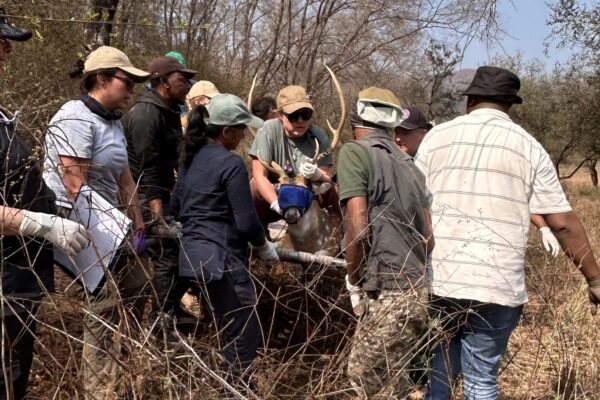
Our first opportunity came sooner than expected when a young male Sambar deer (Rusa unicolor) appeared alone on the path. Jessica and Nikhil formed the darting team alongside Dr. Parag Nigam and Dr. Issac Lekolool. The dart placement was well executed, and within ten minutes the Sambar was safely recumbent—though rather inconveniently beside a thorny bush. Kathryn and Jessica safely applied the blindfold while Jon led the team in transferring the deer onto a stretcher and moving him to a shaded, flat area. Weighing 147 kg, he was an beautiful animal to work with. The monitoring team carried out systematic ABC/TBR assessments and placed an IV catheter, running in IV fluids, while the morphometrics and sampling teams efficiently collected their data. Throughout the procedure, he remained stable and required no additional top-up drugs. After administering the reversal agent, we watched with relief as he recovered and returned to his feet.
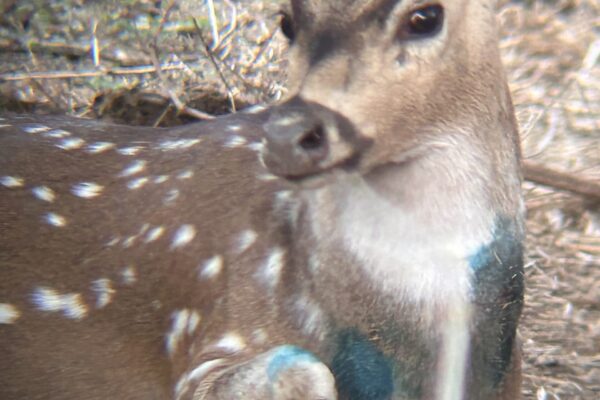
A quick brunch of sweets and some cookies gave us some energy to head for our next assignment of the day, a Spotted deer (Axis axis). This time, Muktar and Jullia stepped into the darting roles. The forest, however, decided to challenge us. Humans strayed into the working area, one dart bounced off target, and there was a moment of uncertainty about drug administration. To add to the complexity, the deer sought shelter in a tricky spot up a hill after being darted. These real-life challenges tested our communication, patience, and problem-solving skills. Both teams quickly came together, coordinating efforts to safely reposition the deer to a workable location. It was a good demonstration of teamwork in a challenging setting. Once stabilized, we carried out ABC/TBR monitoring, placed an IV catheter and administered fluids, and completed morphometrics and sampling without complication. When the reversal was given, the deer rose, and after initial disorientation, moved directly toward the direction of his family—a simple yet deeply satisfying moment that brought a collective sense of accomplishment.
After a long, hot and physically demanding day, tea and snacks in the field really hit the spot. We lightened the atmosphere with some games to test our reflexes (drop the stick challenge) and a charades version of Chinese whispers, reminding us that strong teams are built not only through pressure but also through shared laughter
During the evening debrief, we reflected on the day’s experiences while our tutors provided feedback. Today, we truly operated as primary responders, with the tutors stepping back, allowing us to learn through action. Back at the accommodation, a quick power nap and tea break revived us for the final session of the day, where Nic Masters and Amanda Guthrie delivered an insightful discussion on biobanking and blood gas analysis—topics highly relevant to our everyday practice as wildlife veterinarians in the field.
As the day came to a close, we felt the quiet satisfaction that comes from meaningful, hands-on learning. Today was not just about darting animals; it was about thinking critically under pressure, adapting to unpredictable situations, and working seamlessly as a team. Each challenge strengthened our confidence and reminded us why we chose this path in wildlife health.